TODO Web App
A 3-tier monolith client/server application based on a Node.js + Express + Mongoose API paired with a React + Vite UI for a TODO management application.
- React
- Node.js
- Express
- MongoDB
- Tailwind CSS
- TanStack Query
https://lucaslhh-todo-web-app.netlify.app


1. Description
An 3-tier monolith client/server application based on a Node.js + Express + Mongoose API paired with a React + Vite UI for a Todo management application. With full functionality across creating, editing, completing, and deleting TODOs.
- Add TODO - Add new TODOs to your todo list.
- TODO List - View your remaining TODOs and mark them as done.
- Edit / Delete - Inline editing of existing TODOs and deletion functionality.
2. System Architecture
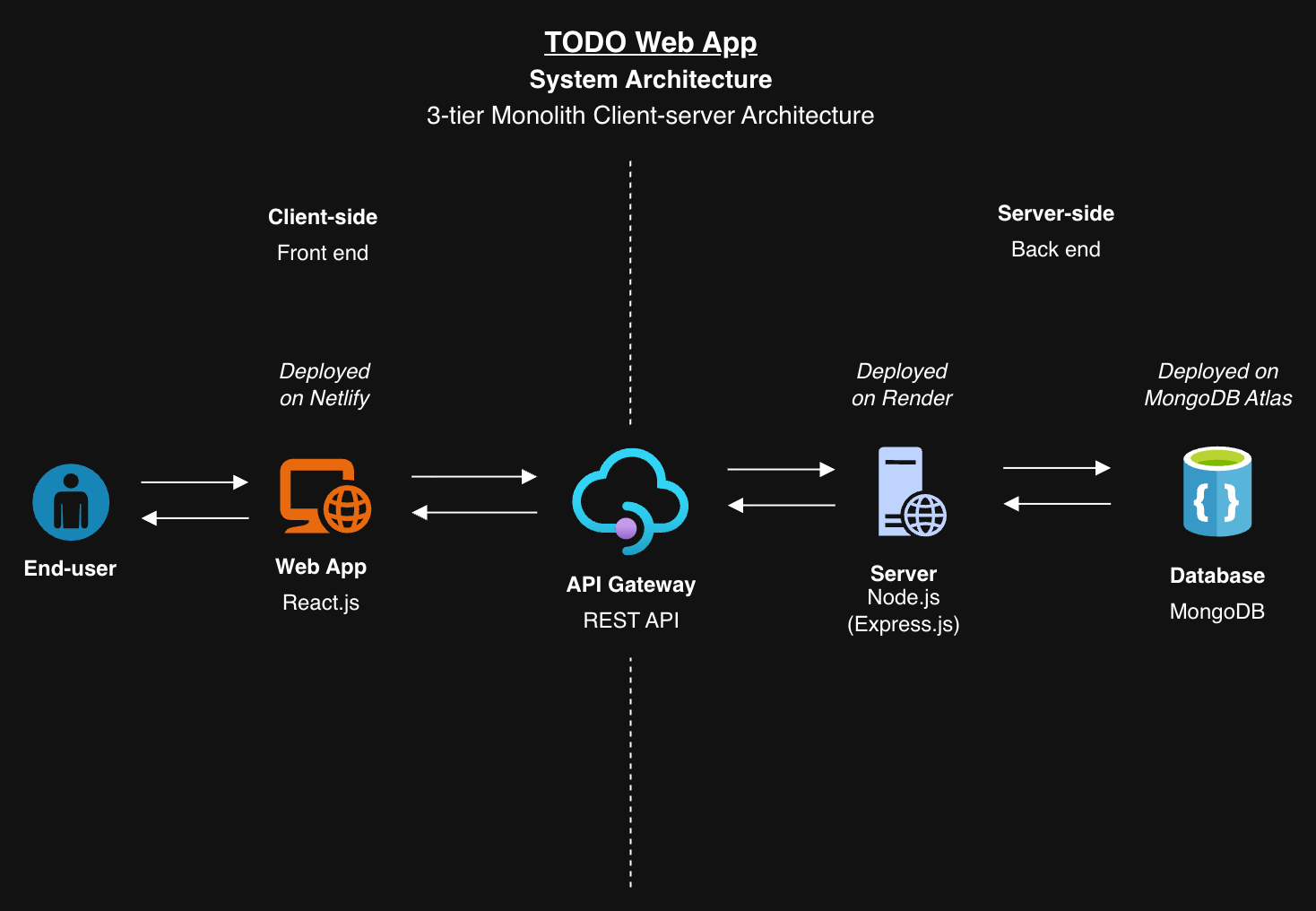
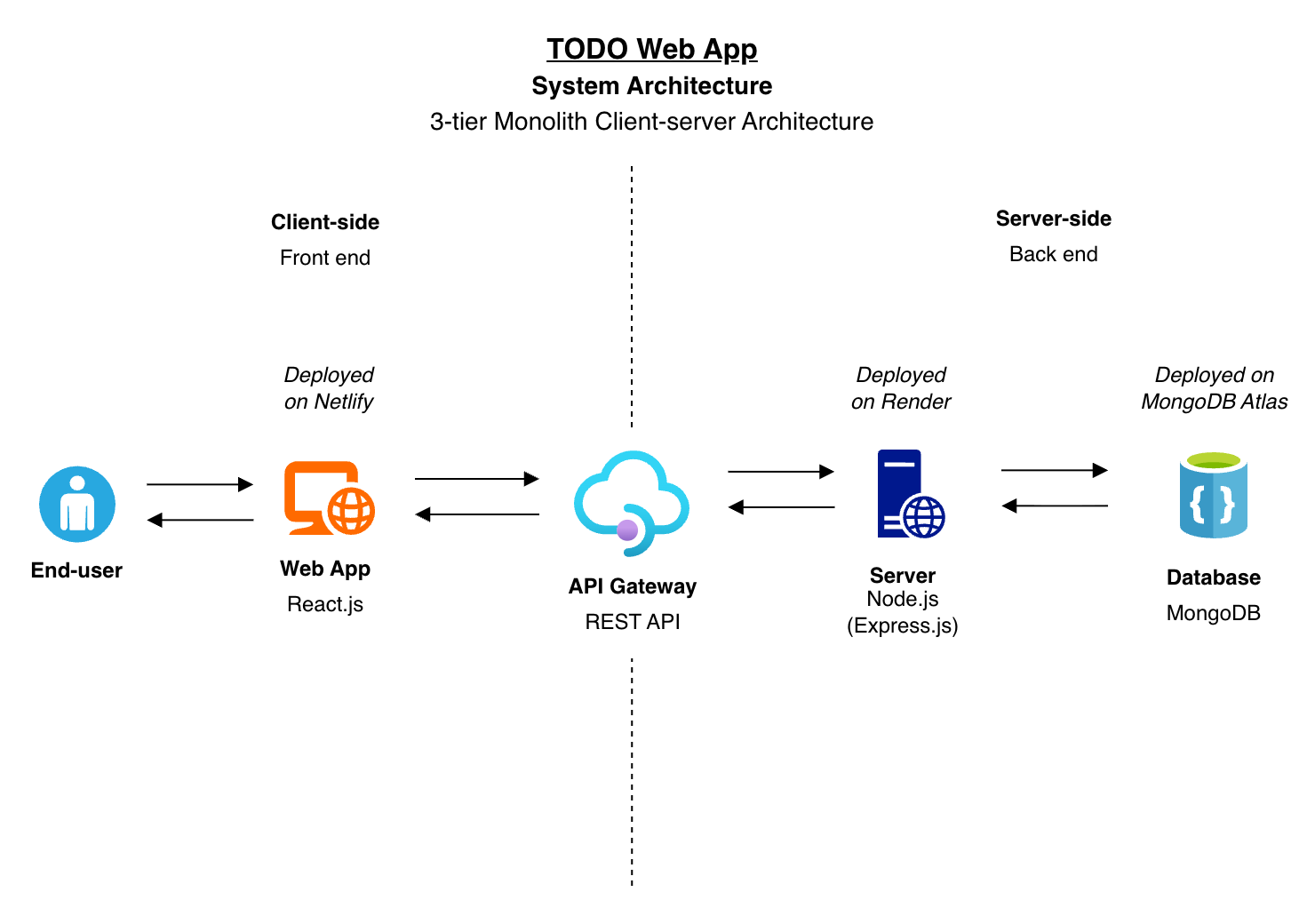
Figure 2.1: System Architecture Diagram
- Frontend: React (Vite), Tailwind CSS v4, TanStack Query (React Query),
react-hook-form. - Backend: Node.js, Express, Mongoose,
express-rate-limitrate limiting, andzodschema validation. - Database: MongoDB.
3. Installation
Requires Node 20+.
git clone <repo>
cd todo_app-web_app
Install dependencies for both the client and server:
cd Workspace/server
npm install
cd ../client
npm install
Copy the env examples and fill in real values (like your MongoDB URI):
# In Workspace/server
cp .env.example .env

# In Workspace/client
cp .env.example .env
Start the MongoDB database (via Docker Compose):
cd Workspace/server
docker-compose up -d
(To stop the database, docker-compose down)
Start the API Server:
npm run dev
Run the Client Web App:
cd Workspace/client
npm run dev    # http://localhost:5173
4. Usage
4.1. Non-functional Features
- Security -
- Rate limit protection for all API endpoints using
express-rate-limitwith 50 requests per minute per IP address.
- Rate limit protection for all API endpoints using
- Input Validation -
- With frontend input forms are validated with
react-hook-formand backend requests withzon. - In the backend request, every property in the request body is validated before touching the controller.
- With frontend input forms are validated with
- Backend Accessibility -
- The API is locked to one origin point by CORS, which is set to the frontend base URL.
- Performance -
- Frontend data fetching and caching is optimised using TanStack Query (React Query).
- UI Responsiveness -
- The UI components and Flexbox layouts can seamlessly handle several screen sizes from desktop to mobile.
4.2. Functional Features
- Add TODO Item -
- Add new TODO item by providing a title and an optional description.
- TODO Management -
- View a list of all TODOs.
- Toggle TODOs between done and pending.
- Inline editing of TODO titles and descriptions.
- Confirmation before discarding unsaved edits or deleting a task.
- Alerts -
- Animated slide-down banners alert the user to successful actions or errors.
Figure 4.2.1: Demo Video
5. Source Code Structure
Click above to direct to video
Figure 5.1: Walkthrough Video
5.1. Frontend (Client) Source Code -
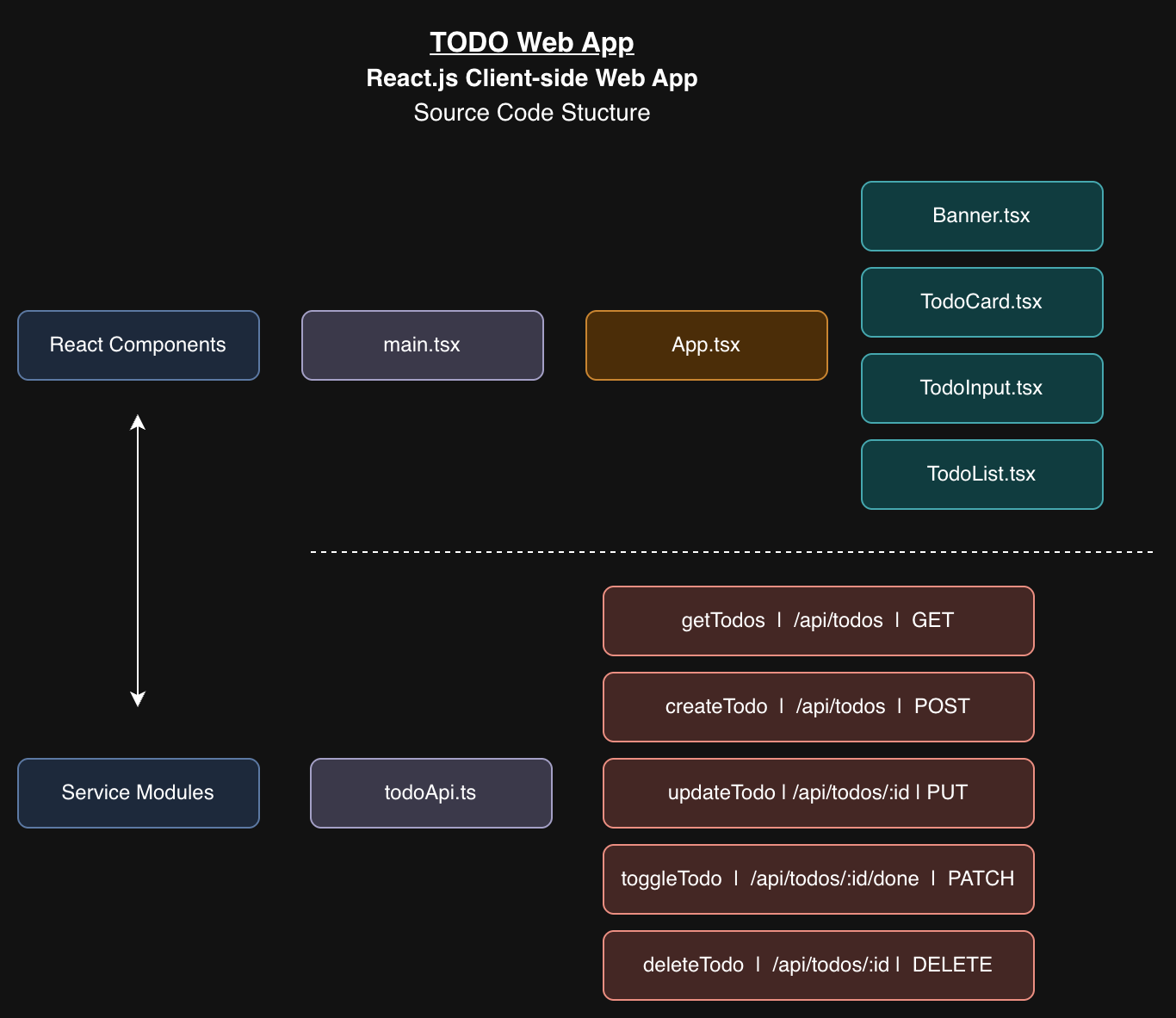
Figure 5.1.1: Client Source Code Structure
The src directory contains the core frontend application code, structured as follows:
main.tsx: The main entry point of the React application that rendersApp.tsxinto the DOM.App.tsx: The main React component that acts as the root of the application, managing layouts and rendering other components.index.css: The global CSS file where Tailwind CSS directives and custom global styles are imported.components/: Contains reusable React UI components that make up the different parts of the application.services/: Contains API service functions for communicating with the backend server (for example, fetching, creating, updating, and deleting TODO items).types/: Contains TypeScript type definitions and interfaces used throughout the application to ensure type safety.
5.2. Backend (Server) Source Code -
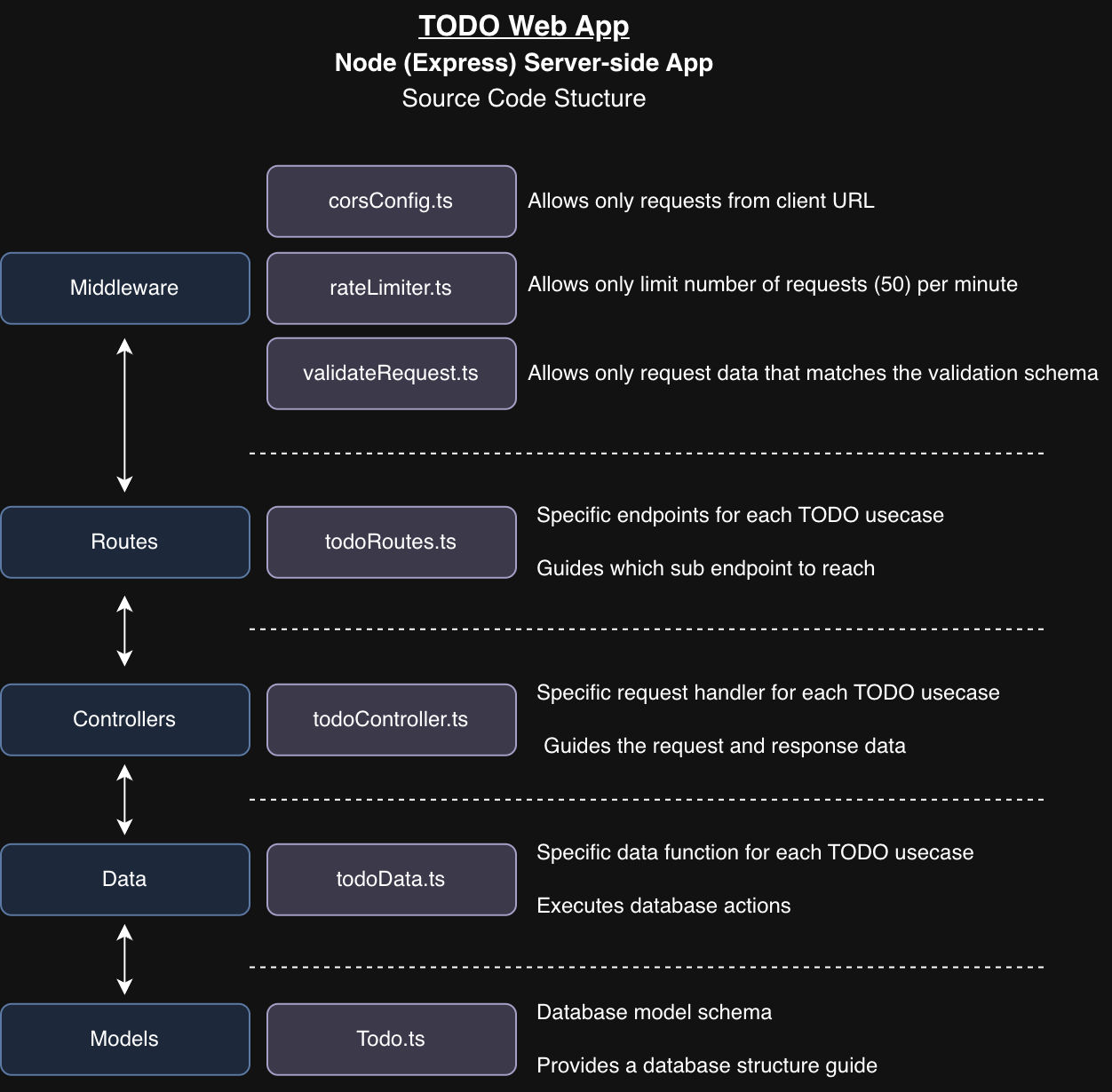
Figure 5.2.1: Server Source Code Structure
The src directory contains the core application logic, structured as follows:
index.ts: The main entry point of the server that initializes the Express application, applies middlewares, and registers routes.config/: Contains configuration files, such as the MongoDB connection setup.schemas/: Contains Zod validation schemas used to validate the structure and types of incoming request payloads.middlewares/: Contains custom Express middlewares, such as rate limiting, CORS configuration, and request data validation.routes/: Contains Express route definitions mapping endpoints to their respective controllers.controllers/: Contains the route handler functions that process incoming requests, interact with the database, and return responses.data/: Contains the database interaction functions.models/: Contains Mongoose schemas and models representing the database structure.
6. Potential Improvements
- Authentication -
- The application currently doesn't have the ability to handle user accounts. But adding a JWT authentication will allow to handle multiple users to manage their own primary TODO lists.
- Pagination -
- In the TODO list, all the TODOs are fetched at once. When the list grows, implementing pagination will reduce the loading time and database load.
- Priority and Tag Catogorisation -
- Having the ability to mark TODOs with priority or grouping several TODOs under tag will allow the end-user to manage pending TODOs efficiently.
- Test Coverage-
- Add unit tests, integration tests and E2E test (example with Playwright or Cypress) will ensure future enhancements won't break the system that was already working.
7. Credits
- The UI was created based on the following image, Clean & Minimal Todo List Design
8. License -
Copyright (c) 2026 H.V.L.Hasanka
Licensed under MIT License